Concrete Foundation Types Best Suited for South Carolina's Climate
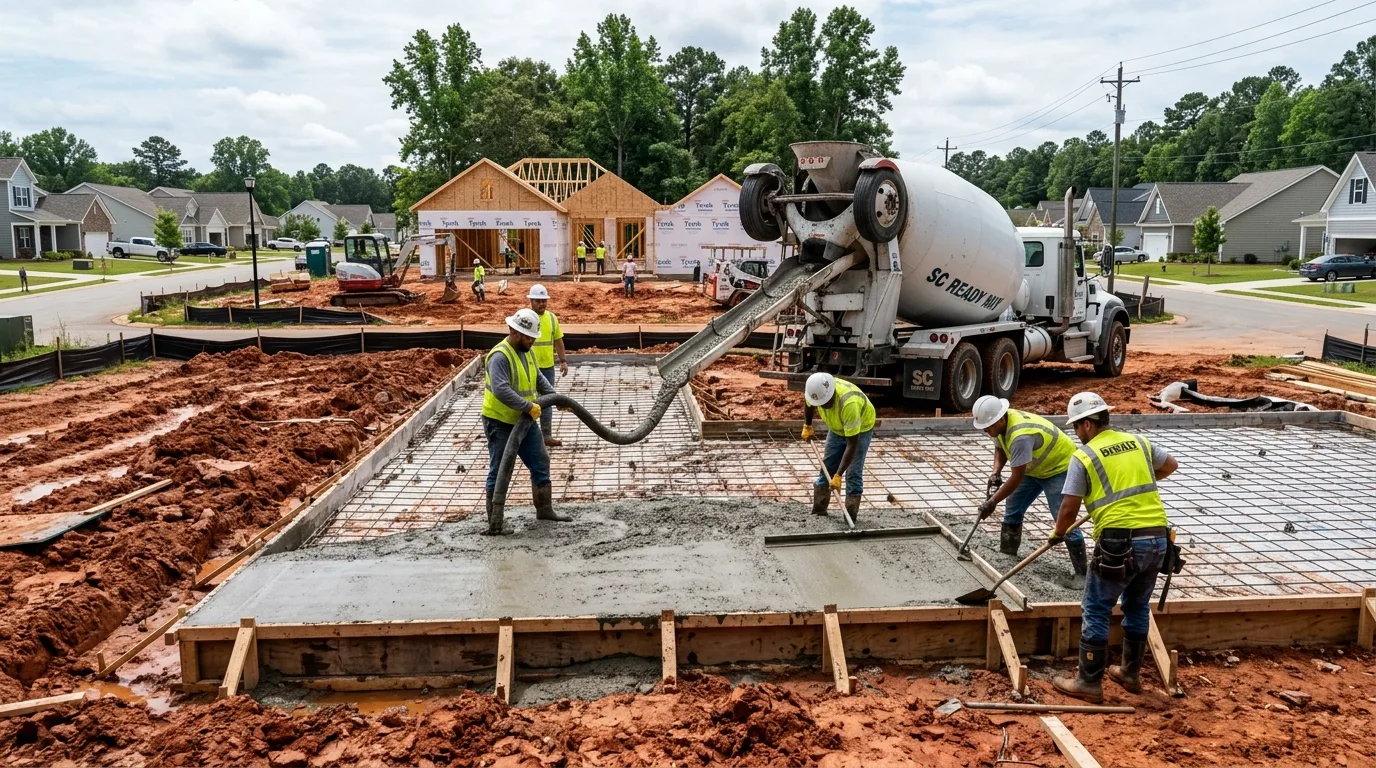
South Carolina’s climate and soil conditions make foundation selection one of the most consequential decisions in any construction project. The Piedmont region — which includes York County, Fort Mill, and Baxter Village — has clay-rich soils that behave very differently from the sandy coastal soils further south, and the foundation type that works best in one part of the state may not be ideal for another.
This guide explains the concrete foundation types used in South Carolina’s Piedmont region, what makes each appropriate or inappropriate for local soil and climate conditions, and what the permit and inspection process looks like for foundation work in York County.
In this post, we will cover slab-on-grade foundations, monolithic slabs, crawl space foundations, and stem wall designs, explaining when each is used, what makes it work in South Carolina’s conditions, and what proper installation looks like.
Planning a Foundation Pour in Baxter Village?
We handle York County permits, inspections, and soil assessment as part of every foundation project. Call (888) 376-0955 for a free estimate.
Why Foundation Type Matters in York County’s Soils
Before the foundation types, a brief note on why this matters specifically in the Baxter Village and Fort Mill area: York County’s clay-rich Piedmont soils are among the most challenging foundation substrates in the Carolinas. Expansive clay soils absorb water and swell, then dry and contract — a shrink-swell cycle that puts lateral and upward pressure on any foundation system placed in or on this material.
Foundations designed for sandy coastal soils or northern climate conditions may not account adequately for clay soil behavior. The foundation types and specifications that work in York County are calibrated for this specific soil challenge.
Slab-on-Grade Foundation
What it is: A concrete slab poured directly on the prepared ground surface, with the slab serving as both the floor and the foundation. The most common foundation type for new construction in the South Carolina Piedmont region.
Why it works in South Carolina: Slab-on-grade eliminates the crawl space that creates moisture management problems in humid climates. South Carolina’s high humidity and warm temperatures make crawl spaces potential sources of moisture intrusion, wood rot, and pest problems — conditions that a slab-on-grade design avoids entirely.
Requirements in York County: A properly installed slab-on-grade in York County requires:
- Adequate excavation to remove expansive clay and replace it with compacted granular fill
- Minimum 4 inches of compacted gravel base (more in high clay content areas)
- Vapor barrier (6 mil poly minimum)
- Rebar reinforcement on standard 18-inch centers, or fiber-reinforced concrete for residential slabs
- Concrete mix of 3,000 PSI minimum (4,000 PSI is better practice for residential use on clay soils)
- Slab inspection by York County Building & Codes before concrete is poured
Common applications: Residential homes, garages, room additions, slab-on-grade workshops, and utility buildings.
Monolithic Slab Foundation
What it is: A variation of the slab-on-grade where the slab and footings are poured as a single unit. The edges of the slab are thickened to form integrated footings, rather than having separate footings poured ahead of the slab.
Why it works in South Carolina: The monolithic design is efficient and cost-effective for single-story construction on relatively stable soils. It eliminates the cold joint (the joint between a separately poured footing and a later-poured slab) that can be a water infiltration point.
Considerations for York County: On highly expansive clay soils, a monolithic slab must be designed with thicker integrated footings than the IRC minimum to resist differential movement. We assess soil conditions before specifying footing depth — in some areas of Fort Mill and Baxter Village, deeper footings are needed to reach soil that is less subject to clay movement.
Common applications: Residential homes under two stories, residential additions, detached garages.
Questions About Foundation Types for Your Baxter Village Project?
We assess soil conditions and recommend the right foundation design for your specific location. Call (888) 376-0955.
Crawl Space Foundation
What it is: A foundation system where the structure sits on concrete or masonry perimeter walls (stem walls) that raise the floor above ground level, creating an accessible space beneath the floor.
Considerations for South Carolina: Crawl spaces in South Carolina’s humid climate require aggressive moisture management — encapsulation, drainage systems, and ventilation — to prevent moisture accumulation that causes wood rot and mold. Unconditioned crawl spaces in this climate are increasingly replaced by slab-on-grade designs or by conditioned (fully encapsulated and air-sealed) crawl spaces.
When it is appropriate in Baxter Village: Crawl space foundations are most appropriate when site conditions — slope, drainage, or flood zone requirements — make a slab-on-grade design impractical. Sloped lots near Lake Haigler and the Anne Springs Close Greenway area sometimes favor crawl space designs. When a crawl space is required, full encapsulation is the current best practice for South Carolina’s climate.
Stem Wall Foundation
What it is: Poured concrete walls extending from footings to grade level, with the floor slab poured separately on top or the structure framed above. Used for both crawl space and basement construction.
In York County: True basements are uncommon in most of York County because of clay soil and high water table conditions in some areas. Partial stem walls for grade changes and elevation adjustments are more common, particularly on sloped residential lots.
What York County Permit and Inspection Requirements Cover
For all foundation concrete work in York County:
- Building permit required before any excavation or forming
- Concrete slab inspection required before concrete is poured (inspector reviews reinforcement, forms, sub-base preparation)
- The inspection must be passed before the pour proceeds — missed inspections can result in required demolition of improperly placed concrete
- Final inspection required for foundation work associated with permitted construction
Fort Mill town limits have separate permitting through Fort Mill Building Inspections. Baxter Village’s HOA may also require ARB review for any exterior additions.
For more detail on the permit process, see our York County concrete permit guide.
Cost Considerations for Foundation Work in Baxter Village
Foundation costs in Baxter Village and Fort Mill vary based on foundation type, footprint size, required excavation depth, reinforcement specification, and the extent of base material replacement needed for clay soil conditions. Proper sub-base preparation — the most important cost item for long-term performance — should never be value-engineered out of a foundation project in York County.
We provide detailed written estimates that separate excavation, base material, reinforcement, concrete, forming, permit fees, and inspection costs so you can evaluate exactly what you are paying for and why.
Foundation Work in Baxter Village — Done Right for SC's Conditions
Call Baxter Village Concrete at (888) 376-0955. We handle permits, inspections, and soil assessment for every foundation project.
Related reading: