5 Signs Your Baxter Village Driveway Needs Replacement, Not Just Repair
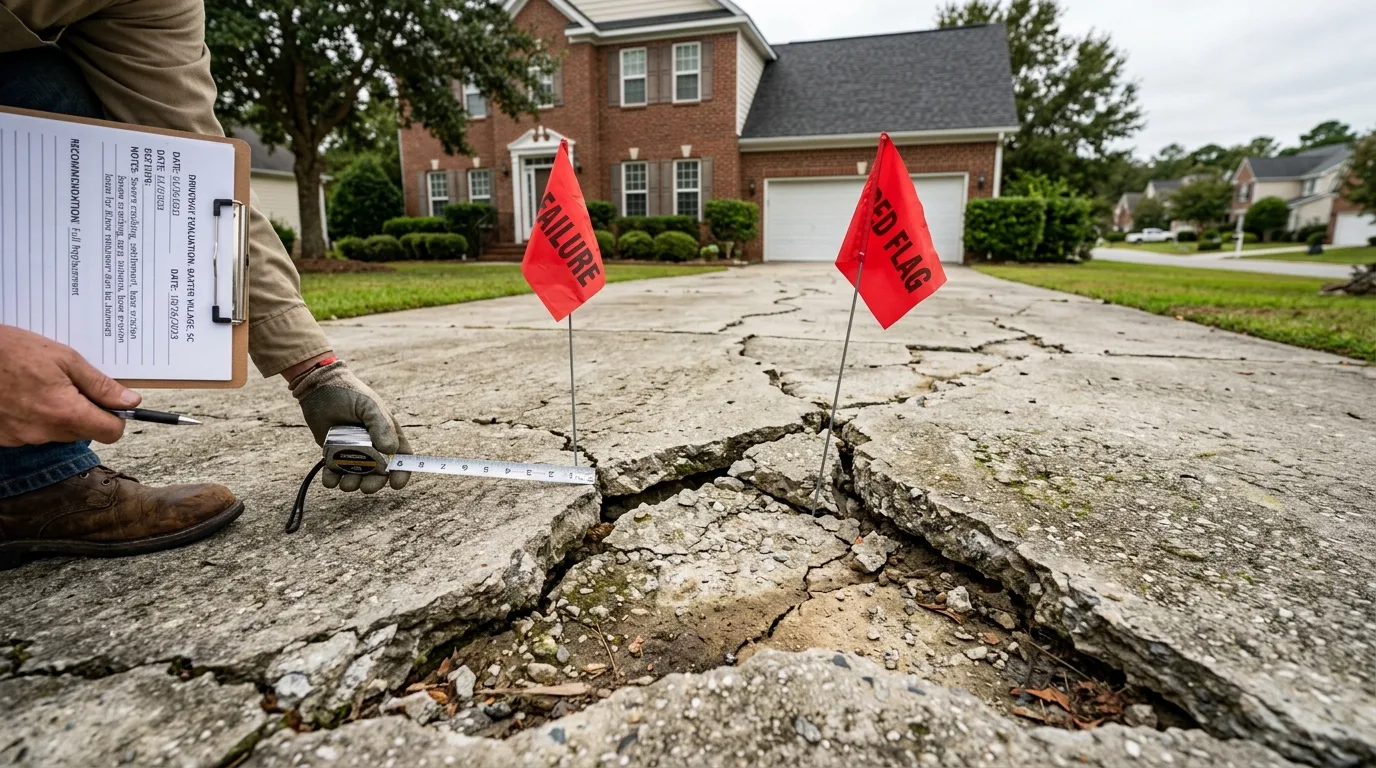
Most Baxter Village driveways were poured when the community was built — between 2000 and 2010. That means many are now 15 to 25 years old and showing the natural wear patterns of concrete that has lived through two decades of York County’s clay soil movement, freeze-thaw cycles, and South Carolina’s summer heat without adequate maintenance.
The question homeowners face at this stage is not whether something is wrong — it is whether repair is still the right call, or whether replacement is the better investment. Making the wrong call costs money either way: unnecessary replacement wastes money when repair would work fine; patching a driveway that needs replacement means paying for repairs that fail quickly on a fundamentally compromised slab.
In this post, we will cover the five clear signs that your Baxter Village driveway has crossed into replacement territory, what causes these conditions in our local environment, and how to decide what makes the most sense for your property.
Not Sure If Your Baxter Village Driveway Needs Repair or Replacement?
We provide free, honest assessments with no upselling. Call (888) 376-0955 or submit your project details online.
Why Baxter Village Driveways Fail Faster Than Average
Before the signs, it helps to understand what stresses concrete in this area. York County’s expansive clay soils absorb water and swell, then dry and contract — a shrink-swell cycle that puts upward and downward pressure on concrete slabs continuously. Without a proper gravel base buffering the slab from soil movement, driveways shift, crack, and settle prematurely.
Additionally, Baxter Village’s mature landscaping — a defining feature of the master-planned community near the Anne Springs Close Greenway — means established tree roots near driveways that can grow beneath slabs and cause displacement over time. And South Carolina’s freeze-thaw cycles, while moderate compared to northern states, are enough to widen small cracks into serious damage over multiple winters without sealing.
Sign 1: Widespread Cracking Through the Full Depth
A few surface cracks or hairline cracks are normal as concrete ages and can be filled. The replacement indicator is cracking that has spread across most of the slab in a network pattern (alligator cracking), or cracks that run through the full thickness of the concrete rather than just the surface layer.
How to check: Look at cracks from multiple angles. A crack you can see daylight through from the side, or one where adjacent sections have moved to different elevations, has gone through the full depth. Surface hairlines that only go a fraction of an inch are still in repair territory.
Why it happens in Baxter Village: The clay soil shrink-swell cycle causes repeated stress cycles that propagate small surface cracks into full-depth fractures over time. Once a crack reaches full depth, water enters and accelerates sub-base erosion, which accelerates cracking further — a self-reinforcing failure mode.
Sign 2: Sections That Have Sunk or Heaved More Than an Inch
Minor variation across a driveway — a quarter-inch step here or there — is normal and usually repairable with mudjacking or grinding. When sections have settled or heaved more than an inch relative to adjacent sections, the sub-base has failed significantly and lifting will not hold long-term.
Why it happens in Baxter Village: The clay soil beneath improperly prepared driveways compresses and shifts differentially — some areas settle as soil dries and voids form; other areas heave as waterlogged soil expands. A heave or settlement greater than an inch typically means the sub-base is compromised over a significant area, not just a localized spot.
Practical test: Walk your driveway and feel for rocking slabs or visible elevation differences at control joints. Water pooling in low spots after rain is a secondary sign.
Let Us Assess Your Driveway at No Cost
Our free assessment takes 15 minutes and gives you an honest repair vs. replacement recommendation. Call (888) 376-0955.
Sign 3: Drainage Failure — Water Running Toward the House
Concrete driveways should slope away from your home — typically at a 1/8 to 1/4 inch drop per foot. When a driveway has settled or heaved unevenly, that slope reverses in places, directing water toward the garage foundation rather than away from it.
This is one of the most consequential failure modes because it affects your foundation, not just your driveway. Water directed toward the foundation perimeter accelerates soil saturation, which in turn causes more clay expansion and foundation settlement.
What replacement solves: A new driveway is graded from scratch with the correct slope designed from your garage down to the street, eliminating the drainage reversal problem permanently.
Sign 4: Spalling Across More Than 25% of the Surface
Surface spalling — where the top layer of concrete breaks away in flakes or chunks, exposing the rough aggregate underneath — is repairable when it is localized. When it covers more than a quarter of the driveway surface, the scale and prep work required for a lasting overlay exceeds the cost difference between overlay and replacement.
Why it happens in Baxter Village: Freeze-thaw scaling is the primary cause: water enters surface pores, freezes and expands, and breaks away the top layer. Concrete that was not air-entrained when originally poured (common in driveways installed before this became standard practice in residential work) is particularly susceptible. Chemical deicers — especially rock salt — dramatically accelerate spalling in any climate.
Sign 5: The Driveway Is More Than 25 Years Old With No Maintenance History
Age alone is not a disqualifying factor — well-maintained concrete can last 40+ years. But age combined with zero sealing history, significant cracking, and any of the above signs is a strong replacement signal. Original Baxter Village driveways from 2000 to 2005 are now at or approaching the replacement threshold, and the community’s clay soil makes those without proper base prep even more vulnerable.
The practical reality: Repairing a 25-year-old driveway with multiple problems often delivers 3 to 5 years of additional service before the same problems reappear on top of or around the repairs. A replacement delivers 25 to 40 years.
Repair vs. Replacement Decision Framework
| Condition | Repair | Replace |
|---|---|---|
| 1–3 isolated cracks | Yes | No |
| Widespread full-depth cracking | No | Yes |
| Settlement < 1 inch, localized | Yes | No |
| Settlement > 1 inch, widespread | No | Yes |
| Spalling < 25% of surface | Yes | No |
| Spalling > 25% of surface | No | Yes |
| Age 0–15 years, properly maintained | Yes | No |
| Age 20+ years, no maintenance | No | Yes |
When in doubt, get an honest assessment from a contractor who explains the reasoning behind their recommendation. Read our concrete repair service page for more on what repair can and cannot fix.
Get an Honest Driveway Assessment in Baxter Village
Baxter Village Concrete provides free repair vs. replacement assessments. We explain our reasoning and give you written options. Call (888) 376-0955.
Related reading: